Pronunciation: xíng, 2nd tone (rising) 拼音 xíng · 注音 ㄒㄧㄥˊ
行 xíng meaning: go/do
to walk; to go; to travel; to do; OK!; capable
Also read háng (row; line; line of business; trade; profession)
- Strokes
- 6
- Radical
- 行 walk enclosure
- Both scripts
- 行
- HSK 3.0
- Level 3
- Poster cell
- Z4
简 = 繁行 is the same in both scripts. Traditional shows Taiwan pronunciation with Zhuyin, and traditional word forms.
Stroke data couldn't load. Check your connection and try again.
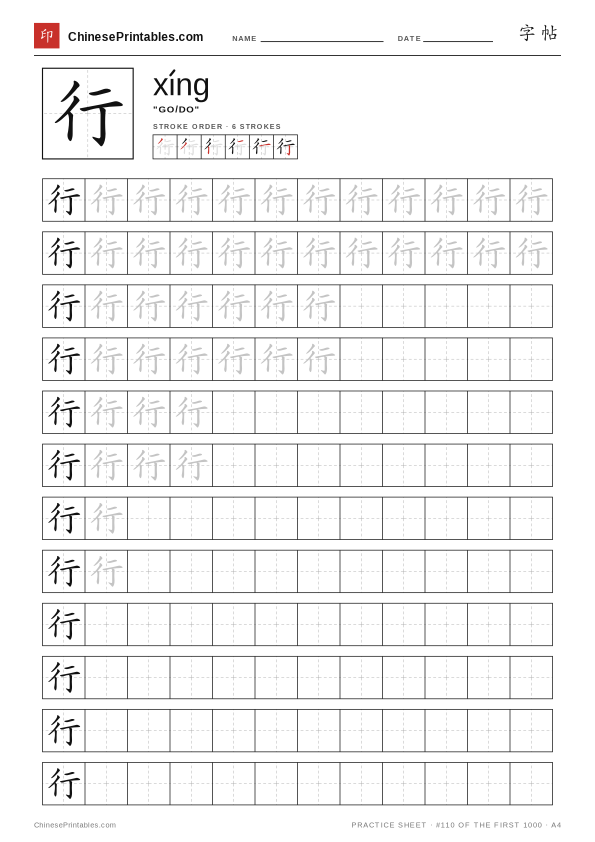
行 practice sheet
A free worksheet for 行 (xíng), ready to print. The pinyin and the stroke order, one stroke at a time, are printed at the top. Each row starts with a model: trace the grey copies, which fade out row by row, then write it on your own in the empty field-grid (田字格) squares.
Practicing a word? Make a sheet for 进行進行
or
your own sentence in the Sentence Writer →
Prefer it blank? Blank 字帖
How is built
Memory aidTo take small steps 亍 with one's feet 彳.
- Radical
- Itself a radical: 行 walk enclosure · Kangxi radical 144
- Layout
- left + right
Also with 彳 5 in the First 1000
行 is a part of 1 in the First 1000
Same syllable, other tones6 in the First 1000
Quick answers
- What does 行 mean in English?
- 行 (xíng) means "go/do": to walk; to go; to travel; to do; OK!; capable.
- How do you pronounce 行?
- 行 is pronounced xíng in pinyin, with the second (rising) tone. With tone numbers it is written xing2. When it means "go/do" it is read xíng. It can also be read háng (row; line; line of business; trade; profession). Press the speaker button next to the pinyin at the top of this page to hear it, and the button next to each example word to hear the word.
- In Taiwan, 行 is pronounced xíng in pinyin, with the second (rising) tone, and written ㄒㄧㄥˊ in Zhuyin (bopomofo). With tone numbers it is written xing2. It can also be read háng (row; line; line of business; trade; profession).
- How many strokes does 行 have?
- 行 has 6 strokes, in both simplified and traditional Chinese.
- What is the radical of 行?
- The radical of 行 is 行 (walk enclosure), Kangxi radical 144.
- Is 行 the same in traditional Chinese?
- Yes. 行 is written the same way in simplified and traditional Chinese.
- What are common words with 行?
- Common words that use 行 include 进行 (jìnxíng, to carry out), 举行 (jǔxíng, to hold), 行动 (xíngdòng, action), 不行 (bùxíng, won't do).
- Common words that use 行 include 進行 (jìnxíng, to carry out), 舉行 (jǔxíng, to hold), 行動 (xíngdòng, action), 不行 (bùxíng, won't do).
- What HSK level is 行?
- 行 is an HSK 3 character in the HSK 3.0 syllabus (2025 edition).
- How common is 行?
- 行 is number 110 of the 1,000 most common Chinese characters, in cell Z4 of The First 1000 poster.

The Master Pack. A print shop for your study desk.
Everything we make, in one download: the first 2,000 characters as posters, practice sheets, reference sheets and flashcards, plus every radicals resource.
- The First 1000: poster (large or 8-sheet self-print), practice sheets, reference sheets, flashcards
- The Second 1000: the same four again, for characters 1,001 to 2,000
- Traditional follows Taiwan (forms, readings, Zhuyin) in the First 1000 resources and both posters
- Essential Radicals, the Radicals Scroll, and The Elements of Chinese
- Bonus: pinyin flashcards and vocab labels
Instant download · Individual PDFs, no zip · Print as many times as you like
Definitions and word glosses adapted from CC-CEDICT (CC BY-SA 4.0). Stroke data from Make Me a Hanzi and, for a few traditional characters in their Taiwan form, AnimCJK (Arphic Public License), animated with Hanzi Writer. Parts and formation adapted from the Make Me a Hanzi dictionary (LGPL); radicals from the Unicode Unihan database; HSK levels from the HSK 3.0 syllabus (2025).