Pronunciation: ge, neutral tone (light, short) 拼音 ge · 注音 ˙ㄍㄜ
个 (個) ge meaning: individual
(classifier used before a noun that has no specific classifier); individual
- Strokes
- 310
- Radical
- 丨 line亻 person
- TraditionalSimplified
- 個 个
- HSK 3.0
- Level 1
- Poster cell
- O1
Stroke data couldn't load. Check your connection and try again.
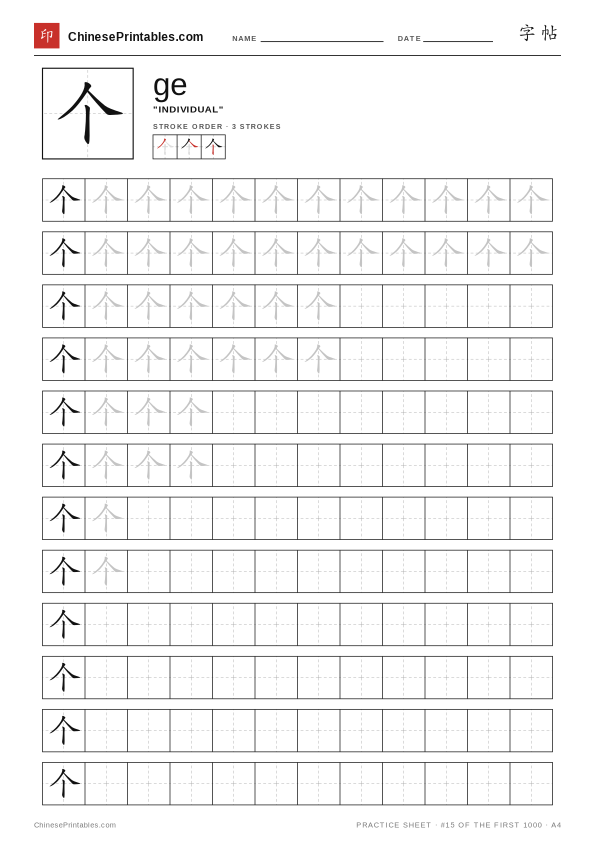
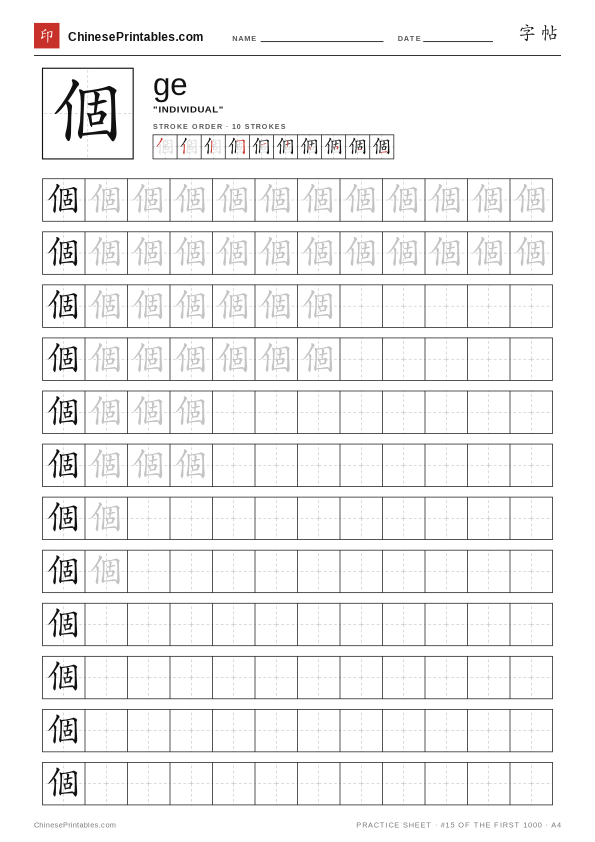
个個 practice sheet
A free worksheet for 个個 (ge), ready to print. The pinyin and the stroke order, one stroke at a time, are printed at the top. Each row starts with a model: trace the grey copies, which fade out row by row, then write it on your own in the empty field-grid (田字格) squares.
Practicing a word? Make a sheet for 个子個子
or
your own sentence in the Sentence Writer →
Prefer it blank? Blank 字帖
How is built
Memory aidA tally 丨 of people 人.
- Radical
- 丨 line · Kangxi radical 2 (in red)
- Layout
- top + bottom
Also with 人 13 in the First 1000
形声Meaning + sound
亻 (person) gives the meaning and 固 (gù) gives the sound. The two sounds have drifted apart over the centuries.
- Radical
- 亻 person · Kangxi radical 9, the side form of 人 (in red)
- Layout
- left + right
Also with 亻 44 in the First 1000
Same syllable, other tones4 in the First 1000
Quick answers
- What does 个 mean in English?
- 个 (ge) means "individual": (classifier used before a noun that has no specific classifier); individual.
- 個 (ge) means "individual": (classifier used before a noun that has no specific classifier); individual.
- How do you pronounce 个?
- 个 is pronounced ge in pinyin, with the neutral tone. With tone numbers it is written ge5. Press the speaker button next to the pinyin at the top of this page to hear it, and the button next to each example word to hear the word.
- In Taiwan, 個 is pronounced ge in pinyin, with the neutral tone, and written ˙ㄍㄜ in Zhuyin (bopomofo). With tone numbers it is written ge5.
- How many strokes does 个 have?
- The simplified form, 个, has 3 strokes. The traditional form, 個, has 10.
- What is the radical of 个?
- The radical of 个 is 丨 (line), Kangxi radical 2. In the traditional form, 個, it is 亻 (person), Kangxi radical 9, the side form of 人.
- What is the traditional form of 个?
- The traditional form of 个 is 個. 个 is the simplified form, used in mainland China and Singapore; 個 is used in Taiwan, Hong Kong and Macau.
- What are common words with 个?
- Common words that use 个 include 个子 (gèzi, height), 个人 (gèrén, individual), 整个 (zhěnggè, whole), 个性 (gèxìng, individuality).
- Common words that use 個 include 個子 (gèzi, height), 個人 (gèrén, individual), 整個 (zhěnggè, whole), 個性 (gèxìng, individuality).
- What HSK level is 个?
- 个 is an HSK 1 character in the HSK 3.0 syllabus (2025 edition).
- How common is 个?
- 个 is number 15 of the 1,000 most common Chinese characters, in cell O1 of The First 1000 poster.

The Master Pack. A print shop for your study desk.
Everything we make, in one download: the first 2,000 characters as posters, practice sheets, reference sheets and flashcards, plus every radicals resource.
- The First 1000: poster (large or 8-sheet self-print), practice sheets, reference sheets, flashcards
- The Second 1000: the same four again, for characters 1,001 to 2,000
- Traditional follows Taiwan (forms, readings, Zhuyin) in the First 1000 resources and both posters
- Essential Radicals, the Radicals Scroll, and The Elements of Chinese
- Bonus: pinyin flashcards and vocab labels
Instant download · Individual PDFs, no zip · Print as many times as you like
Definitions and word glosses adapted from CC-CEDICT (CC BY-SA 4.0). Stroke data from Make Me a Hanzi and, for a few traditional characters in their Taiwan form, AnimCJK (Arphic Public License), animated with Hanzi Writer. Parts and formation adapted from the Make Me a Hanzi dictionary (LGPL); radicals from the Unicode Unihan database; HSK levels from the HSK 3.0 syllabus (2025).